

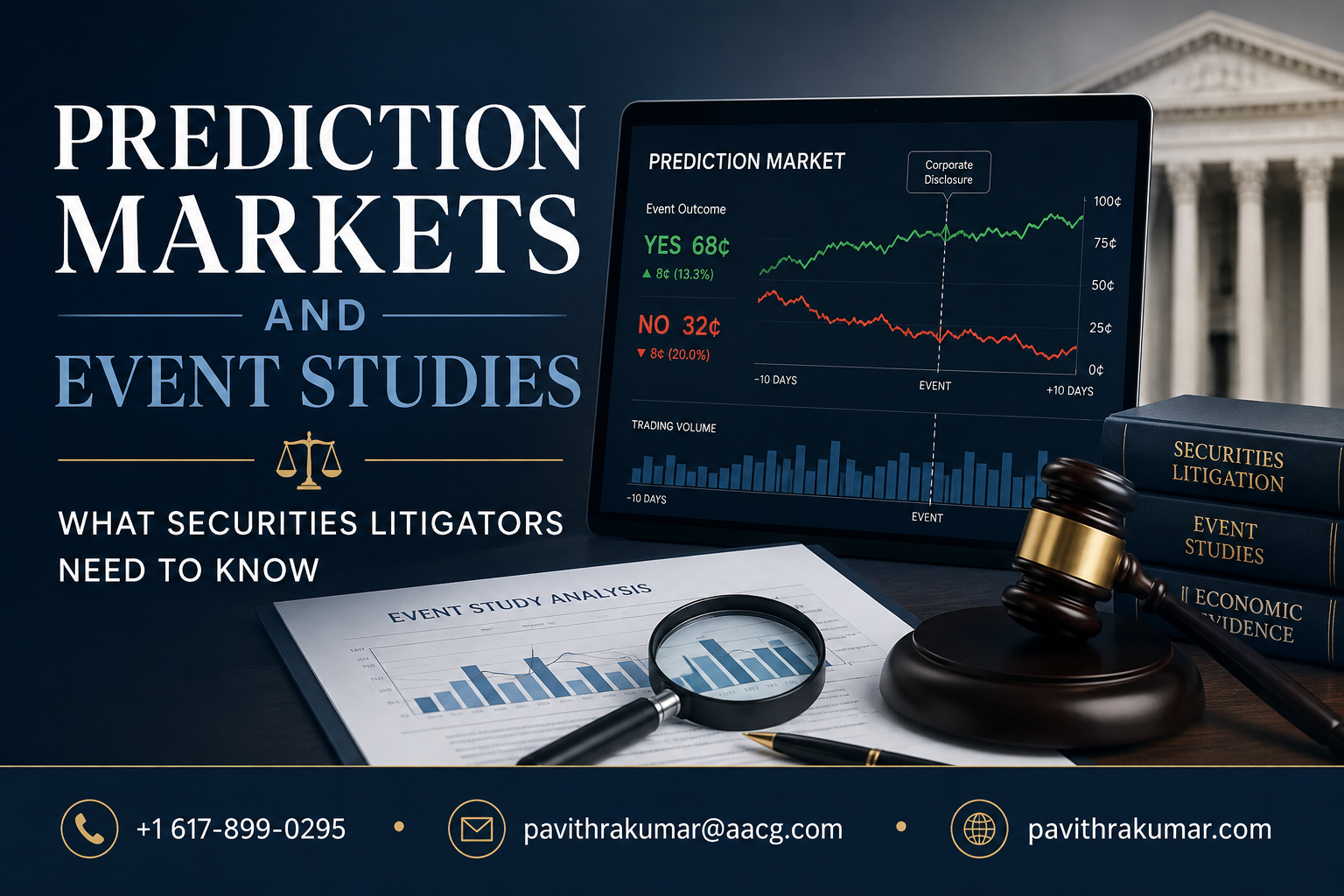
Event studies have been central to securities fraud litigation for a long time. Courts use them to answer one core question: did the company’s disclosure actually move the stock price, or was something else happening that day?
Stock prices, though, are noisy. On any given day, a stock might move because of an earnings report, a Fed announcement, an analyst downgrade, or just general market turbulence. Disentangling the fraud-related drop from all that other noise is where event studies get complicated and where experts on both sides tend to disagree.
That’s why prediction markets are worth paying attention to. They don’t solve every problem, but they offer something traditional event studies have always lacked: a cleaner, more targeted signal.
What is a Prediction Market?
A prediction market is a platform where people trade contracts tied to the outcome of a specific event. The price of a contract reflects what the market thinks the probability of that event is. When new information comes in, prices move.
The key difference from stock prices is specificity. A stock price reflects everything: every risk, every expectation, every piece of news about a company. A prediction market contract is tied to one defined question. If that question is directly related to the alleged fraud, the price movement is much easier to interpret.
Markets like Kalshi and Polymarket have shown that prediction market prices are often accurate and respond quickly to new information. That efficiency is exactly what makes them interesting in a litigation context.
Where Traditional Event Studies Fall Short
To understand what prediction markets offer, it helps to be honest about the weaknesses in standard event studies.
The typical approach is to estimate a “normal” return for a stock using a market model, then measure how much the actual return deviated from that on the disclosure date. The deviation is called the abnormal return, and it’s used to measure price impact.
The Problems:
- There are other things that happen on the same day. Earnings releases, macro news, and analyst reports are also released on the same dates as alleged corrective disclosures. It is important to separate the fraud-related drop, which requires judgment calls that opposing experts will challenge.
- The model assumptions matter. Different market models produce different estimates. The choice of benchmark, estimation window, and return interval all affect the result, and all are open to dispute.
- In smaller or less liquid stocks, abnormal returns are harder to estimate reliably.
None of this makes event studies unreliable. Skilled experts handle these issues every day. But they do create room for dispute, which costs litigants time and money.
How Prediction Markets Could Help
Prediction markets don’t fix everything, but they address a few specific weaknesses directly.
- Cleaner attribution. Because a prediction market contract is tied to a specific outcome, its price movement on a given date reflects only new information relevant to that outcome. That makes it much easier to say: this price change happened because of this disclosure.
- Better counterfactuals. One of the hardest parts of damage analysis is reconstructing at what price the stock would have traded at in the absence of the alleged fraud. For event-contingent outcomes, a regulatory decision, a drug approval, a litigation result prediction, prediction market prices can provide an external, market-based reference point for that counterfactual.
- Less room for methodological dispute. A prediction market price is public and observable – anyone can see what the market thought the probability was. That makes it a lot harder to attack than a regression model where the expert made a dozen judgment calls along the way.
The core appeal is simple: when the fraud is tied to a specific, definable outcome, a prediction market contract may produce a cleaner signal of investor harm than a stock price movement.
What This Means for Damages Analysis
If prediction market data becomes more widely used in securities litigation, damages models will need to account for it.
A few specific applications stand out:
- In cases with multiple partial corrective disclosures, prediction market prices could help attribute the share of the total stock price decline to each disclosure event.
- For securities tied to binary outcomes, drug approvals, regulatory clearances, and merger closings, prediction market prices could support a more precise inflation ribbon over the class period.
- Prediction market data could also be used to corroborate the findings of a traditional event study, rather than replace it entirely.
These aren’t hypothetical. As prediction market data becomes more available and courts become more familiar with how these markets work, their role in expert analysis will likely grow.
The Limitations (And They’re Real)
Any serious treatment of this topic has to acknowledge what prediction markets can’t do, at least right now.
- Coverage is limited. Most prediction markets focus on elections, sports, and macro events. Company-specific litigation and regulatory outcomes are still thinly covered.
- Not every prediction market is reliable. If barely anyone is trading on it, the price may not reflect what the market truly believes – the same way a thinly traded stock does not always reflect fair value.
- Just because a methodology is interesting does not mean a court will accept it. Daubert sets a high bar – the expert needs published support for the approach, a clear sense of its limitations, and the honesty to say so upfront.
- Manipulation is a real concern. Opposing counsel will raise it, and a well-prepared expert will address it directly in the report.
These are genuine constraints, not just theoretical ones. The right approach today is probably to use prediction market data as a corroborating tool rather than a primary methodology and to be rigorous about when it applies and when it doesn’t.
The Bottom Line
Prediction markets may not replace event studies anytime soon. But they represent a real methodological development in securities litigation, with value both as a potential analytical tool and as an approach that opposing experts may begin to use.
For cases involving specific, binary outcomes, prediction market data can improve the analysis in ways that a stock price model alone cannot. As this kind of data begins to appear in securities cases, analysis that accounts for it carefully will rest on a firmer footing than a stock price model used on its own.
Frequently Asked Questions
1. Can prediction market data actually be used in a securities case today?
In the right case, yes, particularly where a liquid market was tracking an outcome directly tied to the alleged fraud. More often, it’s used to support or corroborate a traditional event study rather than stand on its own.
2. How is this different from a standard event study?
A standard event study measures abnormal stock returns. A prediction market approach measures the change in a market-estimated probability for a specific outcome. The second is more targeted, but only works when a relevant, reliable prediction market exists.
3. Which types of cases are the best fit?
Cases built around binary outcomes, regulatory approvals, government investigations, merger completions, and litigation settlements are the most natural fit because prediction markets for those specific outcomes are most likely to exist.
4. Will opposing experts challenge this kind of analysis?
Yes, and that’s appropriate. A well-prepared expert will anticipate the main challenges: liquidity, manipulation risk, and market coverage, and address them in the report before cross-examination.
5. Does this affect class certification arguments?
Potentially. The Basic presumption relies on the efficiency of the market for the defendant’s stock. Prediction markets are separate instruments, and their efficiency would need to be established independently. But in the right case, they could provide supporting evidence in the efficiency analysis.
Have a complex securities matter? Let’s talk.
Dr. Pavithra Kumar provides rigorous, independent analysis in securities litigation, economic damages, and financial analysis. Reach out for a confidential consultation.
Disclaimer: The views and opinions expressed in this article are solely those of the author and are provided for general informational purposes only. They do not necessarily reflect the views, opinions, or positions of CONEXIG, its partners, affiliates, or clients. Nothing in this article should be construed as legal, professional, or other advisory services or opinions, and readers should seek appropriate professional advice for their specific circumstances.