

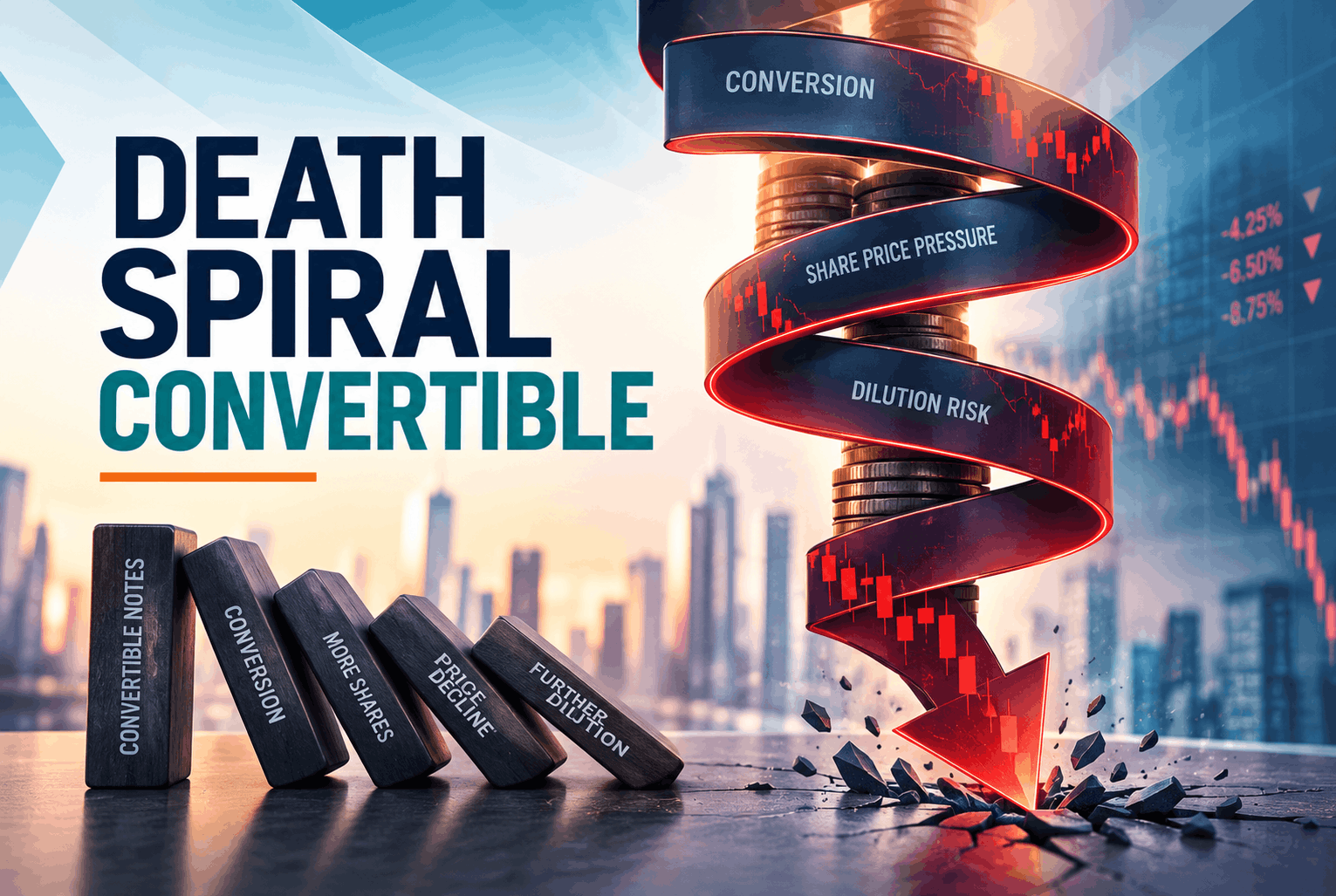
A small company runs low on cash. The bank says no, and a planned stock offering falls through. Then a private investor offers money on the spot, in return for a note that converts into shares at a discount to whatever the price happens to be on the day of conversion. That instrument is a death spiral convertible, and for the shareholders who already own the stock, signing it often marks the start of the end.
Justin Keener made more than $7.7 million running this exact play. He bought convertible notes from tiny public companies, converted them into new shares, and sold those shares into the market. In 2024, a federal appeals court affirmed a judgment against him, topping $10 million. The companies he touched tended to crater, and the losses landed mostly on ordinary investors. Below lays out how the structure works, what decades of finance research show about the outcomes, where these deals end up when they go wrong, and how the loss to shareholders gets measured once a dispute begins.
A Financing Built to Reward the Lender When the Stock Falls
In plain terms, a death spiral convertible is a note or preferred share that converts into common stock at a floating discount to the recent market price. The lower the stock trades, the more shares the holder receives on conversion, and that feedback loop is what earns the instrument its name.
To see why it is so damaging, start with the normal version. Ordinary convertible bonds let the holder swap the bond for a fixed number of shares at a price set in advance. If the business does well and the stock rises, the holder converts and profits. Existing shareholders can accept that, because the conversion price is known from day one.
The floating version flips the arithmetic. The conversion price is set at a discount to the lowest or average trading price over a look-back window, and it resets every time the holder converts. Often, there is no floor. So, when the share price drops, the holder receives more shares for the same note, not fewer. Lower price, more shares, then lower price again. Some people call these instruments toxic convertibles or floorless convertibles.
The core differences line up like this:
| Feature | Ordinary convertible bond | Death spiral convertible |
| Conversion price | Fixed at issuance | Floats down with the share price |
| Shares on conversion | Known in advance | Grows as the stock falls |
| If the share price falls | Holder is less likely to convert | Holder receives more shares |
| Impact on shareholders | Limited and predictable | Heavy, escalating dilution |
The deal usually takes the form of a convertible note, a convertible debenture, or convertible preferred stock. The holder can also short the stock first, convert at the reduced reference price, and use the converted shares to cover the short. That is a form of convertible arbitrage, and it works best on thin, lightly traded stocks where a small amount of selling moves the price. Every conversion adds shares to the float. More shares mean less value behind each one, which is shareholder dilution in an aggressive form. The people who owned the stock first watched both their ownership and their price shrink at once. Pricing an instrument this complex is the kind of problem that calls for specialized financial analysis.
The Spiral in Numbers
Numbers make it concrete. Say a stock trades at $1.00, and the company issues a $1,000 note that converts at a 20 percent discount to the recent low. As the price falls, the same note turns into more shares.
| Share price | Conversion price at 20% discount | Shares from one $1,000 note |
| $1.00 | $0.80 | 1,250 |
| $0.50 | $0.40 | 2,500 |
| $0.20 | $0.16 | 6,250 |
Each drop in the price hands the holder more shares, and selling those shares pushes the price down again. In a thinly traded stock, that pressure moves the price far more than it would in a liquid name; the same thin-float sensitivity that sits at the heart of low-float manipulation matters. That is the ‘death spiral’, running on its own momentum.
This is not a hypothetical. Casmyn Corporation, a small mining company, issued a floating-price convertible in the late 1990s. The stock fell from about $10 to roughly 25 cents, and the share count climbed from 13 million to 40 million as conversions stacked up. The company later filed for bankruptcy. The convertible did not act alone, since the price of gold also dropped, but the design of the instrument turned a rough stretch into a collapse.
So, Why Would Any Company Sign One?
These deals tend to go to small and microcap companies that have run out of cheaper financing options. Many are structured as a PIPE, short for private investment in public equity, where a private investor funds a public company directly instead of through a public raise. PIPE financing can be fast and quiet, and for a company weeks away from missing payroll, speed beats caution.
There is a fair counter-argument, and the research backs part of it. A floating conversion price removes some of the games a company can play when it believes its own stock is overvalued, and for a genuinely promising firm with a long wait before conversion, the structure can cost less than a fixed-price deal. Some companies that took this money were already failing and would have gone under either way. The instrument did not cause every collapse. What the evidence shows is that it made the worst outcomes far more likely and far more severe.
What the Research Reveals About the Death Spiral Convertible
The most thorough study of these instruments, published in the Journal of Financial Economics by Pierre Hillion and Theo Vermaelen, examined 487 issues by 277 companies before 1998. You can read the original study here. The finding was clear. An investor who bought the common stock of an issuer lost about 34 percent of that investment within a year, on average. In 85 percent of cases, the one-year return after the deal was negative, and this happened during one of the strongest bull markets in modern history.
The study also pinned down what drives the damage. The size of the conversion discount was the single strongest predictor of a company being delisted. Deeper discount, worse outcome. Features that pushed holders to wait rather than convert at once, such as caps on the conversion price and attached warrants, lined up with milder declines. Features that looked protective, like conversion floors and paper bans on short selling, did not help and sometimes coincided with steeper drops. So, when it comes time to assess one of these deals after the fact, the discount and the presence or absence of a cap carry the most weight.
When the Losses Turn Into Litigation
These instruments have drawn steady attention from regulators and courts. The Securities and Exchange Commission brought a run of enforcement actions against investors who bought convertible notes from microcap issuers, converted them, and sold the shares, arguing that this activity made the investors dealers who were required to register. In the Keener matter, the Eleventh Circuit affirmed in 2024 that the investor had operated as an unregistered dealer, upholding disgorgement, interest, and penalties that together passed $10 million.
A companion decision, Almagarby, reached the same result earlier that year. In the Keener record, the Commission relied on expert reports finding that 93 percent of the microcap issuers who borrowed from the investor saw their share prices fall, with the harm concentrated among retail investors. Measuring that kind of investor harm sits at the center of securities litigation work.
The definition of a dealer has been the subject of recent rulemaking. In February 2024, the Commission adopted rules that would have widened it. A federal court in Texas vacated those rules in November 2024, and the Commission withdrew its appeal in February 2025. With the appeal withdrawn, those rules are not in effect, while the decisions in Keener and Almagarby still stand.
Private disputes take other routes. Issuers have challenged these notes under the securities laws, under state usury statutes, and under civil RICO, and one remedy that appears in this setting is rescission under Section 29(b) of the Securities Exchange Act, a provision that allows certain contracts made in violation of the Act to be voided. The common thread across these theories is an economic question: how much value did the structure pull away from shareholders, and how should that number be calculated?
Putting a Dollar Figure on the Harm
Once one of these deals becomes a case, the central task is economic, not rhetorical. The question is what the structure costs the existing shareholders, and answering it takes more than pointing at a falling chart.
A careful economic damages analysis starts by separating the decline caused by the convertible from the decline that would have happened anyway. An event study can isolate how the market reacted around the announcement and around each wave of conversions, filtering out broad market and industry moves. From there, the work rebuilds the but-for path: how many shares would exist, and what each share would be worth, if the dilutive terms had never been in place. The gap between that but-for value and what shareholders actually held is the measure of the loss.
Valuation runs alongside the damage work. An independent business valuation can establish what the equity was worth before the conversions began and how that value was carved up as the share count grew. In a thinly traded microcap, it also means separating how much of the price move came from the forced selling itself from how much came from any real change in the business. Done properly, the result is a number that holds up under cross-examination, because every step is transparent and tied to data rather than assertion.
How to Spot One Before the Ink Dries
The warning signs live in the paperwork. These financings surface in public filings, often an 8-K announcing the deal and an S-3 registering the shares for resale, with the resale terms sitting in the plan of distribution section. A few features can indicate how dangerous a given deal is:
- A deep conversion discount to a look-back low. In the research, the size of the discount is the feature most closely tied to a company being delisted.
- No floor on the conversion price, which lets the shares reprice all the way down.
- Permission for the holder to short the stock, which piles selling pressure on top of the conversions.
- On the softer side, a cap on the conversion price or warrants that only pay off if the stock rises, both of which give the holder a reason to wait.
None of this needs a model to notice. The signal is in the note itself, for anyone reading it with those questions in mind.
Frequently Asked Questions
What is a death spiral convertible in plain terms?
It is a convertible note or preferred stock whose conversion price floats down as the share price falls. Because a lower price hands the holder more shares, each conversion adds supply, pushes the price down, and sets up the next round. The result is heavy shareholder dilution and, in many cases, a collapsing stock.
How does it differ from an ordinary convertible bond?
An ordinary convertible bond converts at a fixed price set when it is issued, so the share count is known ahead of time. The floating version converts at a moving discount to recent prices, so the share count grows as the stock falls. One is predictable. The other feeds on its own decline.
Are these financings legal?
The instruments themselves are used in the market, and much of the recent legal attention has centered on the investors who buy and convert the notes. In several matters, courts have found that buying convertible notes from microcap issuers, converting them, and selling the shares made the investor an unregistered dealer under the Securities Exchange Act. The economic question that runs alongside that record is separate: how much value the structure siphons away from existing shareholders.
How are the losses to shareholders measured?
Through economic analysis rather than guesswork. An event study isolates the price impact tied to the deal and the conversions, and a but-for model rebuilds what the shares would have been worth without the dilutive terms. The difference is the estimated loss.
Where do these deals usually show up?
In small and microcap companies that have run out of conventional financing, often as a PIPE, a private investment in public equity. The trades tend to cluster in thinly traded stocks, where a limited amount of selling can move the price.
Bringing the Right Analysis to the Table
One of these financings rarely destroys value in a single dramatic move. It does the damage quietly, one conversion at a time, until the share count has ballooned and the price has caved. By the time a dispute reaches counsel, the question is no longer what happened but how much it cost, and that answer has to be built on data that survives scrutiny.
If you are weighing a matter that involves a death spiral convertible or any similar dilutive financing, I can help you quantify the harm and stand behind the numbers. Reach out to discuss your matter, and the conversation stays confidential.
Disclaimer: The views and opinions expressed in this article are solely those of the author and are provided for general informational purposes only. They do not necessarily reflect the views, opinions, or positions of CONEXIG, its partners, affiliates, or clients. Nothing in this article should be construed as legal, professional, or other advisory services or opinions, and readers should seek appropriate professional advice for their specific circumstances.